
How the Fabrix Agentic Platform delivers vX , and why the platform underneath matters more than the generation layer on top.
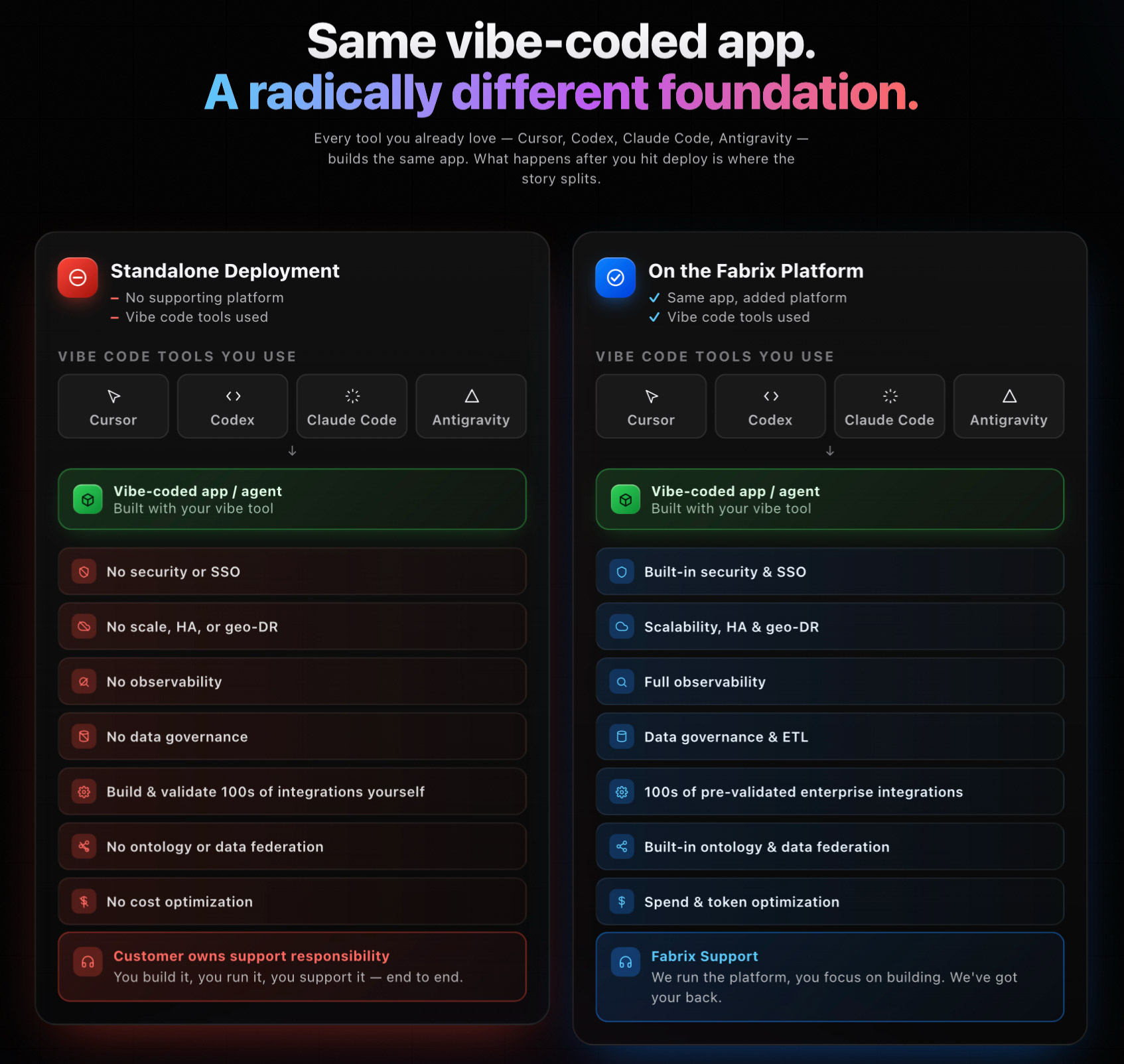
Every tool you already love , Cursor, Codex, Claude Code, Antigravity , can build the same vibe-coded app. That’s not the differentiator anymore. What happens after you hit deploy is where the story splits.
That’s the reality behind Fabrix’s vX , Vibe Coded User Experience. Not a new way to generate apps, but the governed, enterprise-grade platform that makes those apps production-safe, scalable, and operationally accountable. The generation layer is commoditized. The platform underneath it is not.
Two categories of vibe coding players
Before evaluating any vibe coding tool for enterprise use, it’s worth understanding that the market has split into two structurally different categories. Conflating them is where most enterprises make their first mistake.
-
Category 1: AI App Builders Tools like Lovable, Bolt.new, and Replit generate complete applications from a natural language description, including hosting, in minutes. No coding experience required. These platforms are optimized for speed-to-prototype and consumer or SMB use cases. They are not designed for enterprise IT operations , and the security record of 2026 has made that unmistakably clear.
Lovable, the most prominent platform in this category, reached a $6.6 billion valuation with eight million users. It is also the most documented cautionary tale in enterprise AI adoption this year. In April 2026, every project created before late 2025 was readable by any logged-in free account for 48 days after a backend permission change , exposing source code, database credentials, AI chat histories, and customer data across thousands of projects. This followed a February 2026 incident where 16 vulnerabilities, six of them critical, were found in a single app hosted on Lovable’s own platform , exposing 18,697 user records including student accounts. The company closed the original bug report without escalation.
This is not a Lovable-specific failure. It is a category failure. A Q1 2026 assessment of over 200 vibe-coded applications found that 91.5% contained at least one vulnerability traceable to AI hallucination. Research across multiple studies puts the vulnerability rate in AI-generated code at 40–62%. CVEs formally attributed to vibe-coded applications rose from 6 in January 2026 to 35 in March alone, with Georgia Tech researchers estimating the true count is five to ten times higher. The structural problem: AI app builders generate code that works. Not code that is safe. And because most users never read the generated source, vulnerabilities ship silently into production.
- Category 2: AI Coding Assistants Tools like Cursor, Claude Code, Windsurf (now Devin Desktop), and GitHub Copilot sit inside development environments and help engineers write, debug, and ship code faster. They assume coding knowledge. They do not manage hosting, security, or integrations. They accelerate a developer , but they don’t replace the platform that developer needs underneath their work.
The problem with standalone vibe coding in enterprise IT , regardless of tool category
Whether you’re using an AI app builder or an AI coding assistant, the moment a vibe-coded app enters your enterprise production environment without a governed platform underneath it, you face the same set of structural gaps.
- No security or SSO. Authentication and access control have to be built separately, manually, and maintained by your team. Enterprise identity management doesn’t come included. This is precisely how Lovable’s BOLA vulnerability went undetected , there was no security review step in the pipeline, by design.
- No scale, HA, or geo-DR. No built-in high availability, no geographic redundancy, no elastic scaling. The first production spike or regional failure exposes this immediately.
- No observability. You cannot monitor what the app or its agents are doing, what they’re querying, what’s failing, or what’s costing you , because there’s no observability layer attached.
- No data governance. Data lineage, access policies, retention rules, and compliance controls have to be layered on manually , or skipped entirely under deadline pressure, which is what most teams do.
- No ontology or data federation. The app reasons over whatever context it’s handed per session. It has no persistent model of your environment , no understanding of how CMDB entities relate, how configuration changes correlate with incidents, or how assets map across domains. Every session starts cold.
- No cost optimization. Every dashboard refresh, every alert triage, every ad hoc query is a potential uncapped LLM call. At enterprise scale, that compounds into a budget problem nobody forecasted.
- No validated integrations. Connecting to ITSM, observability, networking, databases, and cloud platforms means building and maintaining those integrations yourself , hundreds of them, with no pre-validation against enterprise data schemas.
The result: you own not just the app, but the entire operational burden of everything the platform should have provided.
How the Fabrix Agentic Platform delivers vX , starting with trust and governance
The same vibe-coded app, built with Cursor, Claude Code, or any tool you choose, running on the Fabrix Agentic Platform operates with a fundamentally different set of guarantees. Governance comes first , because the Lovable incidents demonstrated precisely what happens when it doesn’t.
Trust and governance as platform architecture
Agents that perceive, decide, and act across IT systems , remediating incidents, modifying configs, granting access , carry real blast radius in production. The Fabrix platform enforces governance at the architectural level, not as a policy layer bolted on after the fact.
- Least-agency principle. Every agent is scoped to the minimum action authority required for its specific task. A diagnostics agent does not inherit remediation authority. Scope is explicit and bounded, not assumed or inherited.
- Human-agent collaboration by design. Human oversight is a first-class architectural element, not an override fallback. L4 escalations, high-impact remediations, and ambiguous root cause scenarios route to human operators. The agent prepares the full context and ranked options; the human makes the call.
- Auditability. Every agent action , what it queried, what it inferred, what it acted on , is logged against the ontology. Compliance reviewers and post-incident teams can reconstruct not just what happened, but why the agent concluded what it did. That level of traceable reasoning is what enterprise governance actually requires , and what AI app builders structurally cannot provide.
- Evaluations layer. Agent outputs are evaluated before they surface as dashboards or trigger actions. This is the architectural line between a governed vX app and an unvalidated LLM output acted upon in production.
Without these four properties, vibe coding in IT operations is not a productivity tool. It is an uncontrolled variable running inside your production environment.
Grounding in a living operational ontology
A general-purpose copilot , or an AI app builder , reasons over whatever context you provide per session, with no persistent model of your environment. It doesn’t know that db-prod-01 sits in a VPC tied to three downstream applications, or that an ACL change two weeks ago correlates with the latency spike you’re investigating today.
The Fabrix platform’s agents query a continuously updated Entity-Context-Linking (ECL) ontology , a live knowledge graph that maps relationships across your CMDB, metrics, alerts, logs, incidents, and configuration history across every domain. The vX app isn’t improvising structure each session; it’s querying a model that already understands your environment in depth. For root cause analysis, that’s the difference between a generative hypothesis and an evidence-backed conclusion.
Platform capabilities that standalone deployments cannot provide
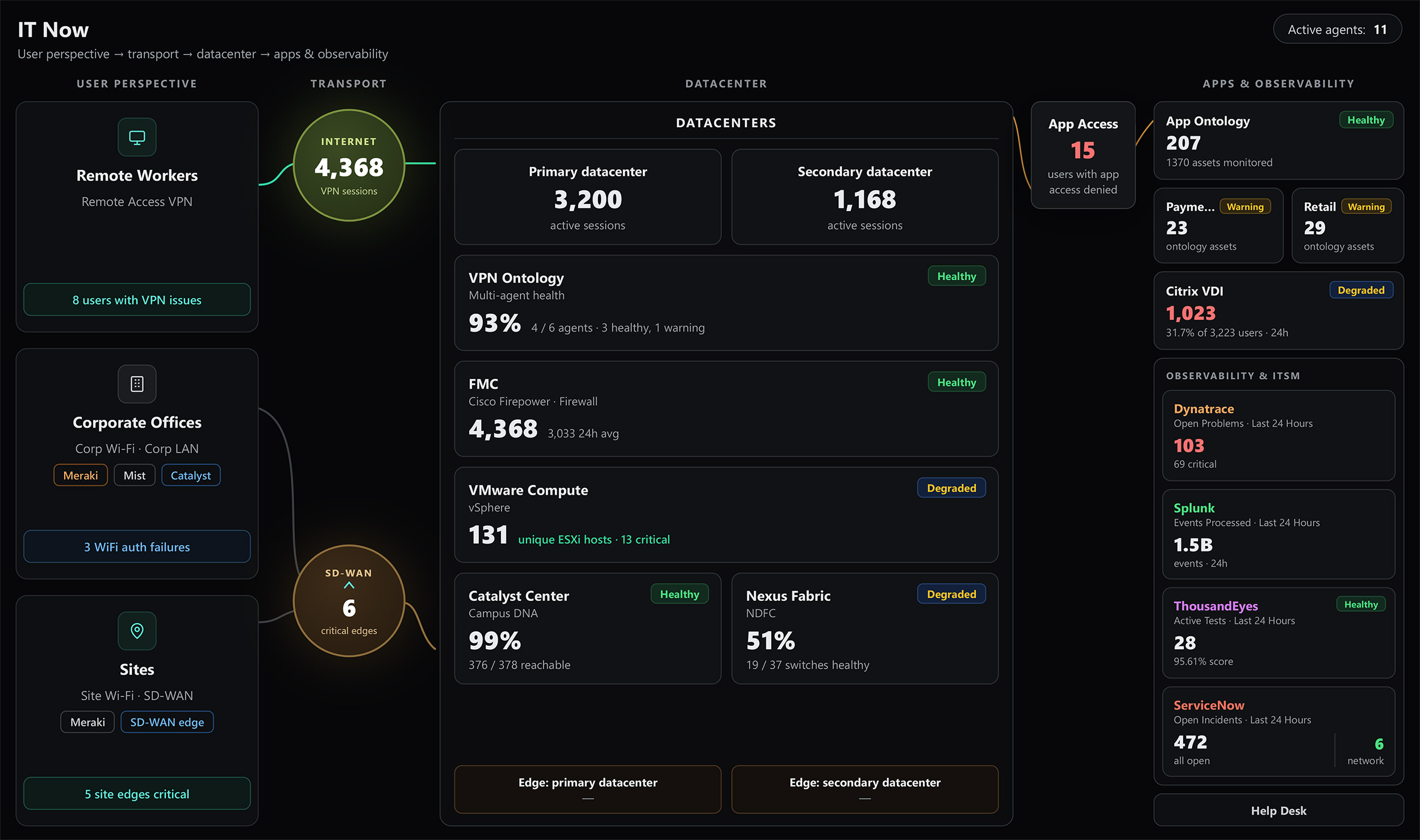
Beyond governance and grounding, the Fabrix platform delivers what neither AI app builders nor standalone AI coding assistants can:
- Built-in security and SSO , enterprise identity integration as a platform service, not a build project. No security review step missing from the pipeline.
- Scalability, HA, and geo-DR , the platform handles availability; every app deployed on it inherits those properties automatically.
- Full observability , agent actions, query costs, failures, and performance are monitored and visible at all times.
- Data governance and ETL , lineage, retention, access policies, and compliance controls are platform-level capabilities, not per-app configurations.
- 100s of pre-validated enterprise integrations , ITSM, observability, networking, cloud, databases, endpoints , validated against real enterprise data schemas. No integration debt to carry.
- Spend and token optimization , non-agentic operations run as deterministic pipelines with no LLM inference cost. Event-driven, on-demand, and proactive agents are scoped and optimized. Token spend is bounded and predictable.
- Fabrix-managed platform , Fabrix runs the platform end to end. You focus on building and operating; Fabrix owns the infrastructure, integrations, and support.
What actually changes: uX to vX
| AI App Builders (Lovable / Bolt) |
AI Coding Assistants (Cursor / Claude Code) |
vX on Fabrix Platform | |
| Target user | Non-technical builders | Professional developers | Enterprise IT & SRE teams |
| Security | Generated, ungoverned | Developer-owned | Built-in SSO, enterprise security |
| Governance | None by design | None by design | Least-agency, auditability, evaluations |
| Data layer | No ontology, no federation | No ontology, no federation | ECL ontology + data federation |
| Observability | None | None | Full agent and platform observability |
| Cost control | Uncapped | Uncapped | Token optimization built in |
| Integrations | Limited, unvalidated | Build yourself | 100s pre-validated enterprise integrations |
| Operations | Platform-hosted, no governance | Developer-managed | Fabrix-managed end to end |
| Enterprise-ready | No | Partial | Yes |
The governance column is the one that determines production viability. It’s also the column that both existing categories leave empty.
The FDE model: how vX scales through SI and OEM partners
This section is commercially distinct from the platform architecture discussion above, and needs to be read separately. The Fabrix Agentic Platform is the governed foundation. The FDE model is how that foundation reaches enterprise accounts at scale , and it opens a partner motion that neither AI app builders nor AI coding assistants have built.
Why Fabrix alone cannot scale FDE delivery
The honest constraint first: Fabrix’s own Forward-Deployed Engineers can deliver vX apps to a limited number of accounts at any one time. FDE delivery is high-touch, environment-specific, and requires deep access to a customer’s operational data, integration landscape, and ontology configuration. That’s a bottleneck if the only FDEs are Fabrix employees.
The strategic answer is to make every SI partner engineer a capable FDE , trained, tooled, and certified to deliver governed vX apps on the Fabrix platform on behalf of their enterprise clients. This is where the partner model becomes the actual go-to-market engine.
The SI partner motion
Systems integrators , Cisco partners, IBM Global Services, major regional SIs , already have trusted relationships inside the enterprise IT accounts Fabrix is targeting. They run the NetOps, ITOps, and SecOps transformation programmes. They are already being asked by clients to deliver AI-powered operations capabilities. What they lack is a governed, enterprise-grade platform to build on top of.
The vX model gives SIs exactly that: a platform where their engineers use whatever vibe coding tool they prefer , Cursor, Claude Code, Codex , to generate the operational app, and the Fabrix platform underneath provides the ECL ontology grounding, the governance layer, the pre-validated enterprise integrations, and the token optimization. The SI delivers the outcome. Fabrix provides the production-grade foundation that makes it safe to deliver.
This is a fundamentally different partner motion from traditional ISV resell. The SI is not reselling Fabrix licenses. The SI is building and delivering governed agentic apps as a professional services capability, differentiated by the Fabrix platform underneath. Their engineers become certified FDEs. Their practice becomes a vX delivery capability. Their clients get apps in days rather than waiting on vendor roadmaps.
For Fabrix, this model means platform revenue at SI partner scale without the linear FDE headcount constraint. For the SI, it means a differentiated AI-native practice with a defensible technical foundation , not just a resell margin on a vendor license.
The OEM partner motion
OEM partners , technology vendors who embed Fabrix’s platform capabilities into their own products , represent a different but equally important vector. Consider the use case: a network management vendor whose customers are asking for agentic operations capabilities. Rather than building a governed agentic platform from scratch , ontology, multi-agent orchestration, evaluations layer, enterprise integrations , they embed Fabrix’s platform as the operational intelligence layer underneath their existing product.
The vX capability becomes the OEM’s delivery accelerant: their field engineers or customer success teams use vibe coding tools to build customised operational apps for each enterprise deployment, in days, grounded in the Fabrix ECL ontology that already understands the customer’s environment. The OEM gets a differentiated AI-native product capability. The customer gets governed, environment-specific operational apps rather than generic dashboards. Fabrix gets platform revenue embedded inside the OEM’s product motion.
This is precisely the pattern that has driven durable platform businesses in adjacent markets , where the platform is not the product the customer buys, but the foundation that makes the product the customer buys production-worthy.
The bottom line
The vibe coding market in 2026 offers speed. It does not, by default, offer governance. The Lovable incidents , the most visible security failures in the category so far , are not edge cases. They are predictable outcomes of a model where code generation is the product and security review is optional.
Enterprise IT operations cannot afford that model. The blast radius of an ungoverned agent action in a hybrid IT environment , a misconfigured firewall rule, an incorrectly escalated access grant, a remediation that masks root cause , is not a bad user experience. It is an incident.
The Fabrix Agentic Platform makes vibe-coded apps enterprise-ready by doing what neither AI app builders nor standalone coding assistants can: grounding them in a live operational ontology, governing every agent action through least-agency and auditability, and delivering at enterprise scale through a certified partner ecosystem of SIs and OEMs.
The word that anchors vX is not fast. It’s governed. The partner model scales the delivery. The platform governs what gets delivered. That combination , governed platform, scaled partner motion , is what makes vX a durable enterprise capability rather than a well-positioned demo.