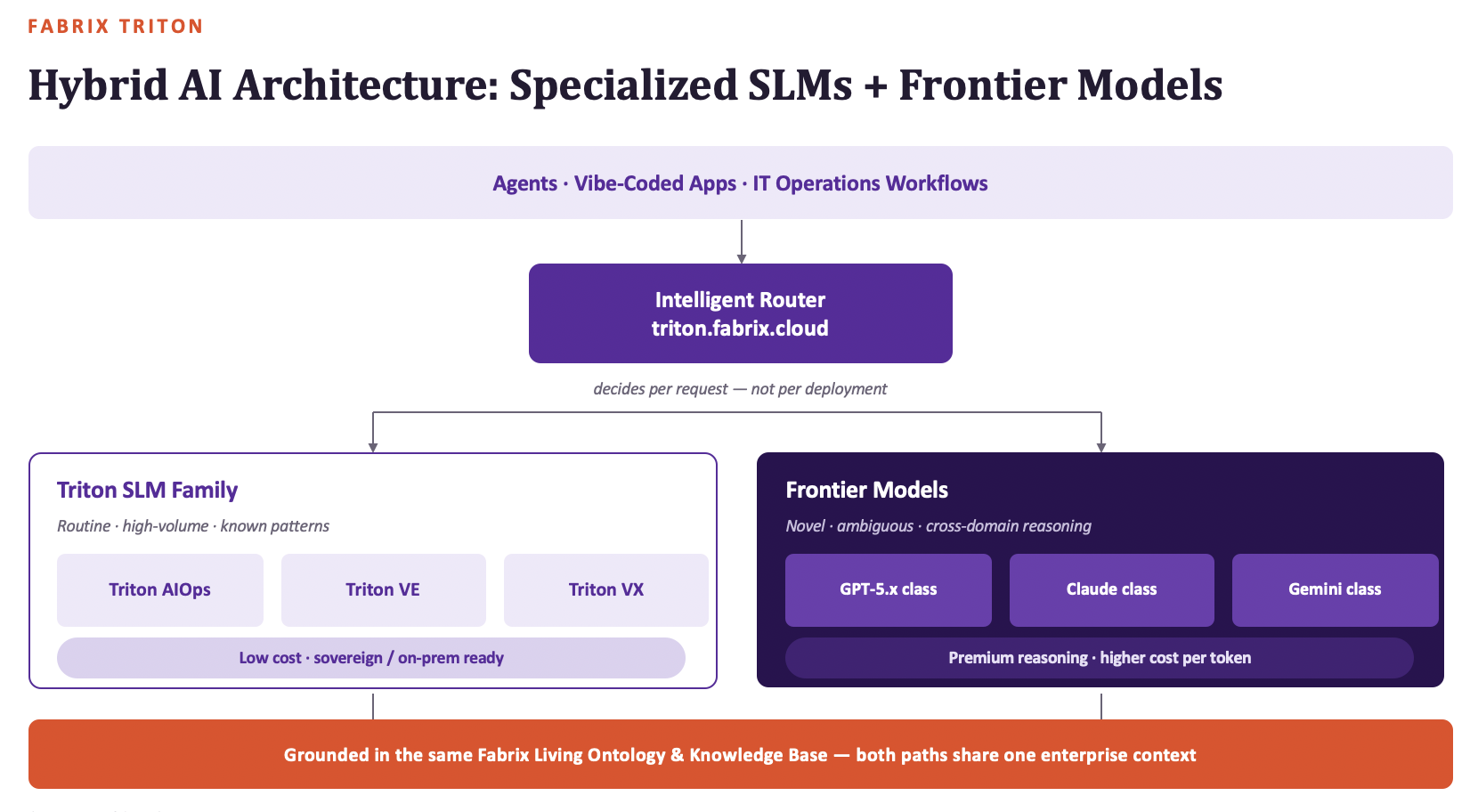
For the last few years, enterprise AI strategy has followed one script: pick the biggest frontier model available, point it at every problem, and pay per token. That script is starting to break down, and Fabrix built Triton because we saw the cracks first.
What Is Triton?
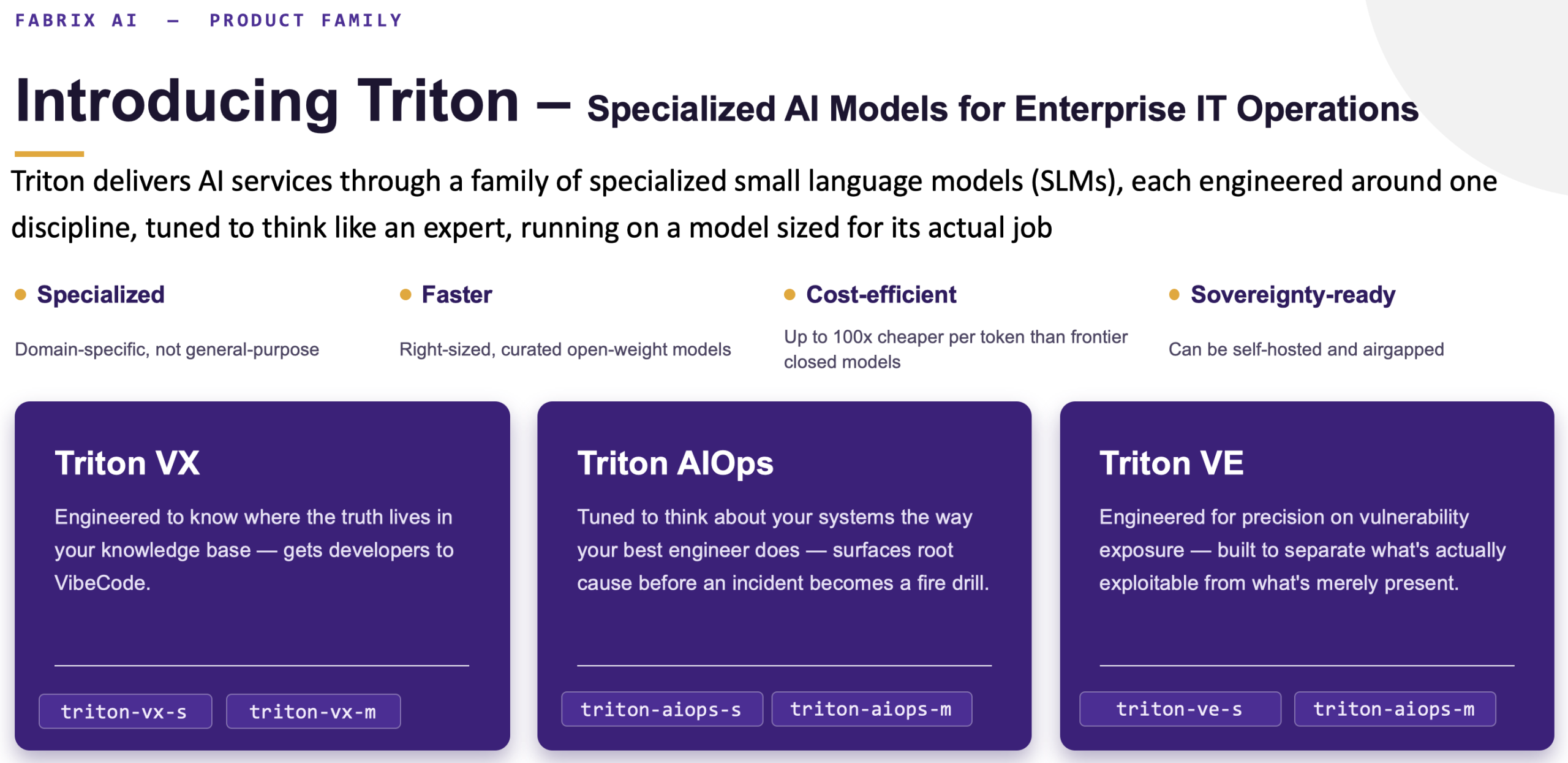
Triton is Fabrix’s family of specialized small language models (SLMs), AI purpose-built for enterprise IT operations. Instead of one giant, general-purpose model trying to do everything, Triton is a family of models, each engineered around one discipline: understanding operational events, assessing vulnerability exposure, or building agentic apps and dashboards. Each model is tuned to think like an expert in its lane, and sized for the job it actually has to do, not the biggest job imaginable.
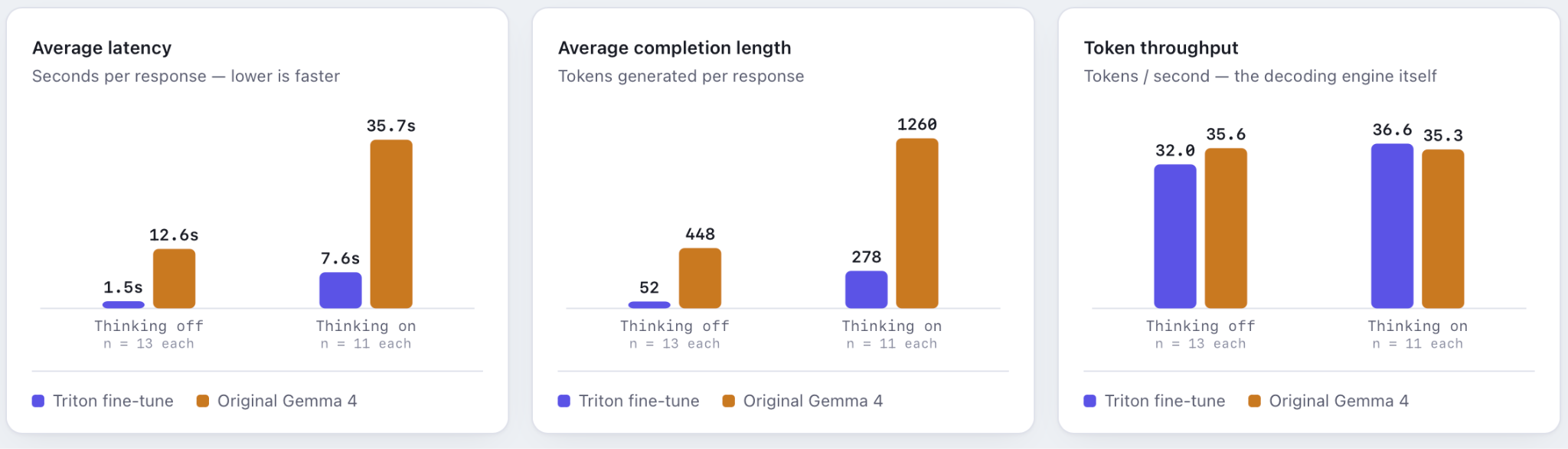
Under the hood, a typical Triton model starts from an efficient open foundation model such as Google’s Gemma, and goes through QLoRA fine-tuning on a purpose-built training dataset. Load the resulting model alongside its foundation model on any GPU, and the result is a working specialist. It’s fast to build, cheap to run, and easy to update as Fabrix’s own product evolves, with no giant retraining cycle required. Triton models are sized to run on a single GPU, in the cloud, on-prem, or fully air-gapped, with response times measured in milliseconds and a fraction of the per-token cost of a frontier model API call. Just as important, each model stays scoped to one discipline instead of spreading its capacity across everything a general-purpose model has to know.
How Triton Is a Game-Changer for Enterprise IT Operations
Most enterprise AI deployments today ask a single frontier model to be a generalist, a specialist, a cost center, and a compliance risk all at once. Triton splits that job up:
- Specialized, not generic. Each Triton model is trained for one discipline, so it performs like a domain expert instead of a jack-of-all-trades guessing its way through IT operations context it was never trained on.
- Sized for the job. Not every question needs a trillion-parameter model. Triton runs the smallest model that gets the job done, which means lower latency and a fraction of the token cost of calling a frontier API for routine, high-volume work.
- Backed by a full agentic stack. Triton doesn’t operate alone. It works with Fabrix’s Agentic Harness – context engineering, caching, and AgenticOps spend/token controls, and behind an LLM Gateway that can route any request to the right model, Triton or a frontier model, depending on what the task actually needs.
- Built for vibe-coded speed. Combined with Fabrix’s Vibe Coded Agentic Ops, Triton lets teams go from idea to a working, published agentic app or dashboard in hours, not sprints.
That combination, specialized models, intelligent routing, spend controls, and fast app development, is what turns Triton from “another small model” into infrastructure that changes how fast enterprise IT operations teams can move.
Typical Usage
Triton shows up wherever enterprise IT operations teams need fast, accurate, cost-efficient answers instead of a slow, expensive round-trip to a frontier model:
- Triton VX powers vibe coding on the Fabrix platform. For example, a help desk administrator can describe an app in plain language and have an interactive dashboard for triaging VPN, Wi-Fi, and app-access issues live across the enterprise the same day.
- Triton AIOps gives AI agents event intelligence. When a monitoring tool fires an alert, an agent asks Triton AIOps whether it’s safe to ignore, what related logs to check, and what the likely root cause is, grounded in Fabrix’s own operational knowledge base.
- Triton VE keeps vulnerability exposure checks current. Agents query Triton VE, continuously updated on public and private CVEs including Mythos & OpenAI Cyber vulnerabilities, to know exactly which checks to run and where, instead of researching CVE databases from scratch in every customer environment.
Solving Today’s Enterprise AI Adoption Challenges
Every enterprise piloting AI right now runs into some version of the same walls. Triton was built to answer each one directly:
- Token Maxxing. Enterprises are discovering that billing by the token doesn’t guarantee value, some are burning through annual AI budgets in months. Triton’s small, task-sized models cut the cost of high-volume, routine work by an order of magnitude compared to frontier APIs, without giving up accuracy on the tasks they’re trained for.
- The Vertical Gap. General-purpose frontier models are trained on the open internet, not on your ITSM tickets, your runbooks, or your network telemetry. Triton is trained specifically on IT operations disciplines, so it performs like a specialist where generic models guess.
- The Sovereign Gap. Enterprises increasingly want control over their models, their compute, and their data, not another recurring bill to a vendor that owns the weights. Because Triton models are small, open-foundation-based, and fine-tuned in-house, they’re built for exactly this kind of ownership and, where needed, on-prem or sovereign deployment.
- Faster development and operationalization of agentic apps. Standing up a new agentic app or workflow used to mean a development backlog. With Triton VX and Vibe Coded Agentic Ops, IT operations teams can go from idea to a published, working app in hours or days, no dev queue required.
Triton is Fabrix’s answer to a simple observation: enterprise AI doesn’t need one enormous model trying to do everything. It needs the right model, sized and trained for the job in front of it, and the intelligent infrastructure to get every request to the specialist that can actually answer it.
Enterprises have been here before. A decade ago, the assumption was that everyone would eventually standardize on a single cloud provider, then reality set in, and hybrid and multi-cloud architectures became the default, because different workloads simply have different needs. AI is following the same trajectory. The winning architecture was never going to be the single biggest model; it’s the one that routes each request, in real time, to whichever model, specialized or frontier, actually fits the job. That’s the architecture Triton was built to run.