
Recent headlines about critical PHP vulnerabilities sent organizations worldwide scrambling to assess their exposure and patch systems. AI is increasing the speed and scale of cyber threats and vulnerabilities, so the real question is how prepared enterprises are to handle them. Technology debt can no longer be ignored, and reactive vulnerability management is no longer enough. Agentic-speed threats demand agentic-speed defense.
One Fabrix enterprise customer runs a complex multivendor network and security estate spanning Cisco, Juniper, Arista, and Palo Alto Networks, all managed through the Fabrix Agentic Ops Platform. Before the vulnerabilities made the news, always-on Fabrix CVE Agents had already investigated the infrastructure, assessed exposure, and opened remediation tickets with supporting evidence and actionable guidance. While others were still reacting to the headlines, this customer’s investigation-to-remediation loop was already underway. By the time the news broke, the work had already started.
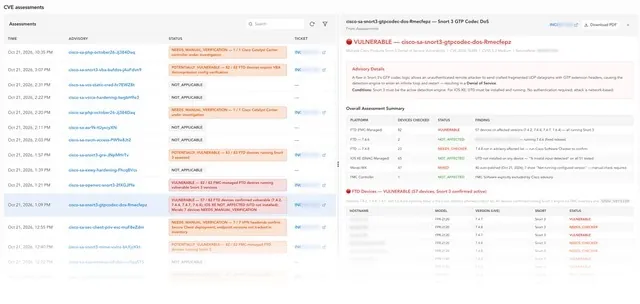
Here is what one afternoon looked like for this customer. Shortly after Cisco published a new batch of advisories, the agents had worked through more than a dozen of them across FTD, ASA, FMC and Catalyst Center. For each one they looked past the software version and checked whether the affected feature was actually in use on the device. Several came back not applicable and were closed out with the evidence attached. Others were flagged as potentially vulnerable or set aside for a quick manual check. The clearest case was a Snort 3 denial-of-service flaw, where the agents confirmed 17 FMC-managed FTD firewalls on an affected release with Snort 3 active, and a ticket with the device list, running versions and fix guidance was already waiting for the security team.
Autonomous AI agents and closed-loop workflows can compress a vulnerability investigation and remediation cycle that once took days into a fraction of the time. That shift turns vulnerability management from reactive firefighting into proactive defense, and Fabrix CVE Agents delivered exactly as designed.
Don’t wait for the headlines. Stay ahead of the game with CVE & Remediation AI Agents.
Frequently Asked Questions
What are Fabrix CVE Agents?
Fabrix CVE Agents are AI agents that automate vulnerability impact analysis. They read new security advisories, compare the affected products and versions against the live inventory of network and security devices, and report which assets are exposed, so operations and security teams know exactly what to fix.
Which vendors do Fabrix CVE Agents support?
Fabrix CVE Agents work across multivendor environments. In the deployment described here, the customer network includes Cisco, Juniper, Arista, and Palo Alto Networks devices, and the agents assessed Cisco advisories for FTD, ASA, FMC, and Catalyst Center.
How do AI agents speed up vulnerability management?
AI agents remove the slowest manual steps in vulnerability management: reading advisories, gathering device and software version data, and checking each asset for exposure. Because the agents do this autonomously, work that usually takes days can be completed in hours, giving teams more time to remediate before a vulnerability is widely exploited.
What happened with the Snort 3 denial-of-service advisory?
When Cisco published a Snort 3 denial-of-service advisory, Fabrix CVE Agents checked it against the customer’s environment and confirmed 17 FMC-managed FTD firewalls on an affected release with Snort 3 active, a ticket with the device list, running versions and fix guidance was already waiting for the security team.