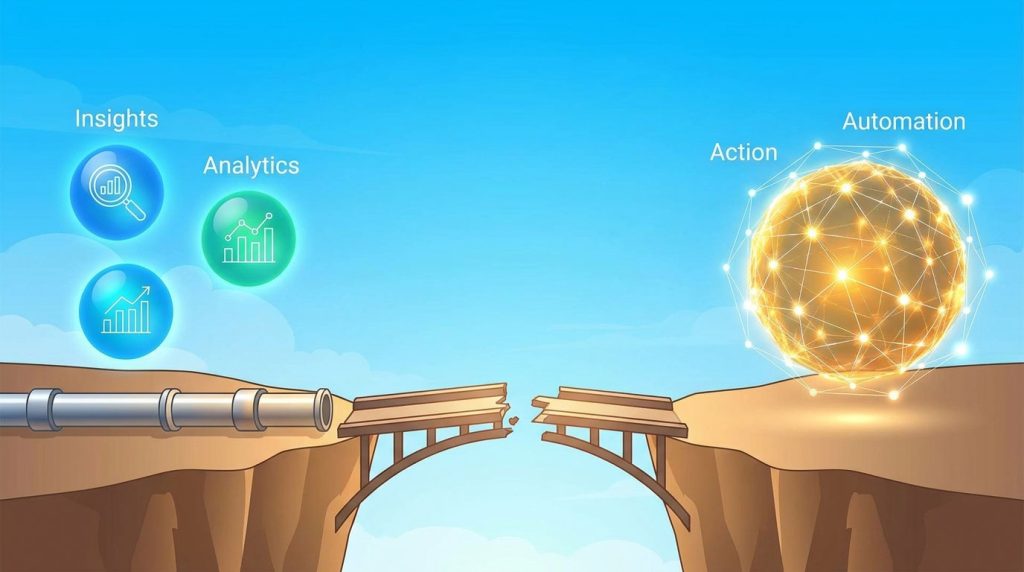
Most enterprise AI initiatives are stuck in proof-of-concept because they were sold as a model decision. They are actually a unit-economics decision. Here is what changes when an enterprise federates data the agentic way.
An executive perspective from Fabrix.ai | For CEOs, CFOs, CIOs, and COOs
Walk into any boardroom in 2026 and the AI question has shifted. It is no longer “Are we doing AI?” It is “What did we get for the money?” Most enterprises cannot answer that crisply. They have copilots in pilot, agents in evaluation, vendors on retainer, and very little measurable impact on the income statement. The reason is rarely the model. It is the data plumbing underneath.
Fabrix.ai’s pattern, Agentic Data Federation, is interesting to a finance leader for one reason: it changes the unit economics of AI from a cost center experiment into a P&L lever. This article unpacks where those returns actually come from, in the language of margin, MTTR, capex, and risk rather than in the language of architecture diagrams.
Key takeaways
- Enterprise AI is a unit-economics decision, not a model decision, and most programs stall in proof-of-concept because of the integration tax beneath them.
- Agentic Data Federation from Fabrix.ai sends AI agents to data where it lives, federating existing tools against a shared, automatically maintained operational ontology.
- The approach offers four ROI levers: lower incident costs, elimination of per-use-case integration builds, protection of existing tool investments and reduced AI risk.
- Compared with siloed tools and static federation, agentic federation targets minutes to resolve P1 incidents, weeks to first AI use case and declining unit cost per use case.
- A zero-copy, additive model preserves existing observability, ITSM, security and CMDB investments while tracing every tool call and model invocation for a complete decision trail.
Why Most AI Programs Fail the CFO Test
The pattern is familiar. A business unit identifies an AI use case. IT inventories the data. Someone discovers it lives across thirty tools, in five formats, with three different names for the same customer. A two-quarter integration project gets scoped. A vendor is hired. The pilot ships in eighteen months, by which time the original sponsor has moved roles and the underlying systems have changed. Net P&L impact: indistinguishable from zero. Net cost: very real.
This is the integration tax. It is the single largest reason AI investment is not converting to AI value. Every new agentic use case in the traditional model effectively requires a new pipeline, a new schema mapping, and a new round of system integration consulting. The marginal cost of the second use case is almost as high as the first. That is not a model the CFO can scale.
What Agentic Data Federation Actually Buys You
Agentic Data Federation is a different operating posture for enterprise data. Instead of moving data into a new central store and rebuilding integrations every time a new agent is deployed, AI agents go to the data where it lives, federate it across existing tools, and reason against a shared operational ontology that the platform maintains automatically.
Translated into business terms, that posture changes four things on the financial model: it collapses incident and operating costs, eliminates the integration tax on every new use case, protects the existing technology balance sheet, and de-risks the AI program itself. Each is worth examining on its own.
ROI Lever 1: Collapsing the Cost of an Incident
For any enterprise that runs digital revenue, downtime and degradation are not IT line items, they are revenue events. Industry benchmarks consistently put the cost of a major incident in the hundreds of thousands of dollars per hour, not counting reputational and SLA-credit knock-on effects. The conventional response, siloed observability tools, war rooms, manual correlation across vendors produces mean times to resolution measured in hours or days.
Agentic Data Federation changes the curve. When agents can traverse a unified, ontology-grounded view of the entire stack, the same incident is triaged in minutes instead of hours, with a ranked root cause and a complete decision trail. For a Fortune 1000 enterprise running a few dozen P1 incidents a year, the avoided-loss math alone typically pays back the platform several times over before any other benefit is counted.
ROI Lever 2: Eliminating the Integration Tax
The second lever is structural and arguably more important over a multi-year horizon. In the traditional model, every new AI use case demands its own integration build. In an agentic federation model, the platform already knows the entities, the relationships, and how to reach the underlying systems. The marginal cost of the second use case is dramatically lower than the first; the third lower still.
For finance leaders, this is the operating leverage moment. AI stops behaving like a series of bespoke capital projects and starts behaving like a platform with declining unit costs. That is the distinction between AI-as-cost-center and AI-as-margin-engine, and it shows up directly in run-rate engineering spend, integrator fees, and the time-to-revenue of every new initiative the business wants to fund.
ROI Lever 3: Protecting the Installed Base
Most enterprises have spent the past decade investing heavily in observability, ITSM, security, CMDBs, and analytics tooling. Those investments are on the books, in the operating budget, and in the muscle memory of the teams that use them. A federation model that requires ripping any of that out is a non-starter at the board level.
Agentic Data Federation is explicitly a zero-copy, additive model. Existing tools are not replaced; they are made agent-ready. That preserves the depreciation schedules, contract commitments, and team competencies already in place, and it protects the CFO from having to re-justify a wave of replacement spend to fund the AI strategy. The installed base becomes an asset of the AI program, not an obstacle to it.
ROI Lever 4: De-risking AI Itself
Boards are increasingly asking a sharper version of the AI question: not “What is your AI strategy?” but “What is your AI risk posture?” That includes hallucination, bias, data leakage, regulatory exposure, and the audit trail behind any autonomous decision.
An ontology-grounded federation model addresses this at the foundation rather than as an afterthought. Agents reason over curated, structured operational knowledge rather than raw, unverified data which materially reduces hallucination risk. Every tool call and model invocation is traced with full payload visibility and PII protection, producing a complete decision trail with reasoning, evidence, and policy checks. For regulated industries, that is not a feature; it is the difference between a defensible AI program and an undefensible one.
The TCO Comparison the Board Actually Cares About
Strip away the architecture vocabulary and the three available approaches to enterprise data federation produce very different five-year TCO profiles. The summary below is what a CFO should actually run through their model.
| Cost & Risk Dimension |
Gen 1: Siloed Tools |
Gen 2: Static Federation |
Gen 3: Agentic Federation |
| Integration build per use case | Repeats every project | Heavy upfront, brittle on change | Near-zero marginal cost |
| Mean time to resolve P1s | Hours to days | Hours | Minutes |
| Existing tool investments | Preserved but siloed | Partially preserved | Fully preserved, agent-ready |
| Time to first AI use case | 12–18 months | 9–12 months | Weeks |
| Hallucination & audit risk | High; manual oversight | Moderate; partial lineage | Materially reduced; ontology-grounded with full provenance |
| Cost trajectory of the Nth use case | Linear – each one a new project | Sub-linear but reconfiguration heavy | Compounding – declining unit cost |
Time-to-Value: Quarters, Not Years
There is one more number worth foregrounding: time-to-first-value. Traditional consolidation programs typically take twelve to eighteen months before the first agentic use case ships, and the second use case starts the same clock again. A federated model with a pre-built agent catalog, a visual builder, and pre-wired connectivity to thousands of systems compresses that into weeks for the first use case and days for subsequent ones.
For a CEO or CFO planning a multi-year transformation, this changes the storyline they tell investors. AI stops being a long-dated, capex-heavy bet and starts looking like a near-term operating improvement program with measurable quarterly milestones.
What This Means for the Boardroom
The strategic question for the C-suite is no longer whether to invest in AI; it is which architectural posture will let those investments compound. An organization that continues to fund per-use-case integration builds will spend more, ship slower, and accumulate more risk than one that establishes a federated, ontology-grounded operating layer once and reuses it everywhere.
Fabrix.ai’s recognition across multiple Gartner Agentic AI categories and its placement among the 2025 Top 50 Agentic AI platforms reflect a market that is starting to converge on this view. The companies that move first will set the operating standard for their industries. The companies that wait will pay the integration tax for years to come and explain that bill to their boards.
Agentic Data Federation is not a technology purchase. It is a unit-economics decision. And like every important unit-economics decision, it is best made at the executive table, not in the backlog.
To model the ROI and TCO impact in your environment, request a working session with the Fabrix.ai team at fabrix.ai/request-demo.
Frequently Asked Questions
What is Agentic Data Federation?
Agentic Data Federation is a Fabrix.ai pattern in which AI agents go to enterprise data where it already lives, federate it across existing tools, and reason against a shared operational ontology that the platform maintains automatically. It avoids moving data into a new central store and rebuilding integrations each time a new agent is deployed, which lowers the cost of every additional AI use case.
What is the integration tax in enterprise AI?
The integration tax is the repeated cost of building a new pipeline, schema mapping and round of system integration work for every new AI use case. Because data often lives across many tools and formats, each project can take quarters to deliver, and the second use case costs almost as much as the first. It is the main reason AI investment fails to convert into value.
How does Agentic Data Federation reduce incident costs?
Agentic Data Federation reduces incident costs by letting agents traverse a unified, ontology-grounded view of the entire technology stack. Incidents that siloed tools and manual war-room correlation take hours or days to resolve can be triaged in minutes, with a ranked root cause and a complete decision trail. Faster resolution limits revenue loss during downtime and degradation.
Does Agentic Data Federation require replacing existing IT tools?
No. Agentic Data Federation is a zero-copy, additive model, so existing observability, ITSM, security, CMDB and analytics tools are not replaced but made agent-ready. This preserves depreciation schedules, contract commitments and team skills already in place, and it avoids having to justify a wave of replacement spending to fund an AI strategy.
How does agentic federation compare with siloed tools and static federation?
Agentic federation offers lower marginal cost and faster results than earlier approaches. Siloed tools repeat integration work every project, take 12 to 18 months to the first AI use case and resolve P1 incidents in hours to days. Static federation takes 9 to 12 months and resolves P1s in hours. Agentic federation targets weeks to first use case, minutes for P1s and declining unit costs.