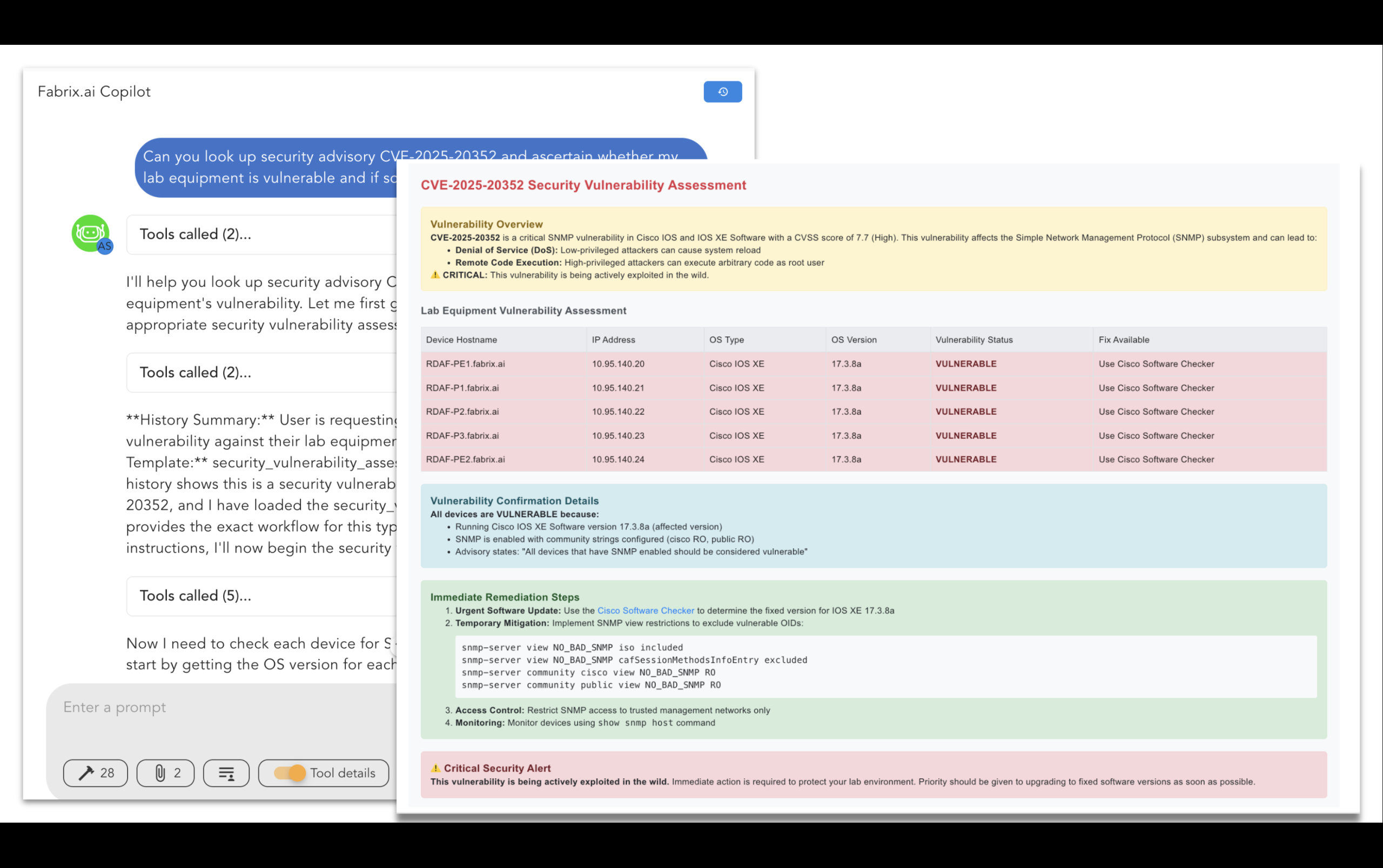
Fabrix VE Agent tells you exactly what’s hit, where it’s hit, and what to do next.
Mythos and OpenAI Cyber are making Security and Vulnerability exposure analysis impossible to ignore. AI-powered threat intelligence is now surfacing vulnerabilities faster than any human team can manually triage, pushing enterprises from reactive patching cycles into a world where exposure windows are measured in hours, not weeks.
The enterprises that will survive this shift are the ones that automate the response, not just the detection. Knowing a VE exists is no longer the hard part, knowing exactly which of your 10,000 assets in your environment are exposed, how critical the blast radius is, and having a remediation ticket auto-generated before the attacker moves laterally: that’s the new baseline. Fabrix’s Vulnerability Exposure Agent reacts and closes that gap as soon as the vulnerability is detected.
Security and network operations teams face a brutal daily reality: vulnerability feeds pour in from every direction, threat intelligence platforms, AI security scanners, vendor advisories, yet translating a VE into a prioritized, device-specific action plan still takes hours of manual correlation. Fabrix.ai’s Vulnerability Exposure Agent changes that with a six-stage automated workflow that goes from raw vulnerability ingestion all the way to ITSM change/remediation ticket creation.
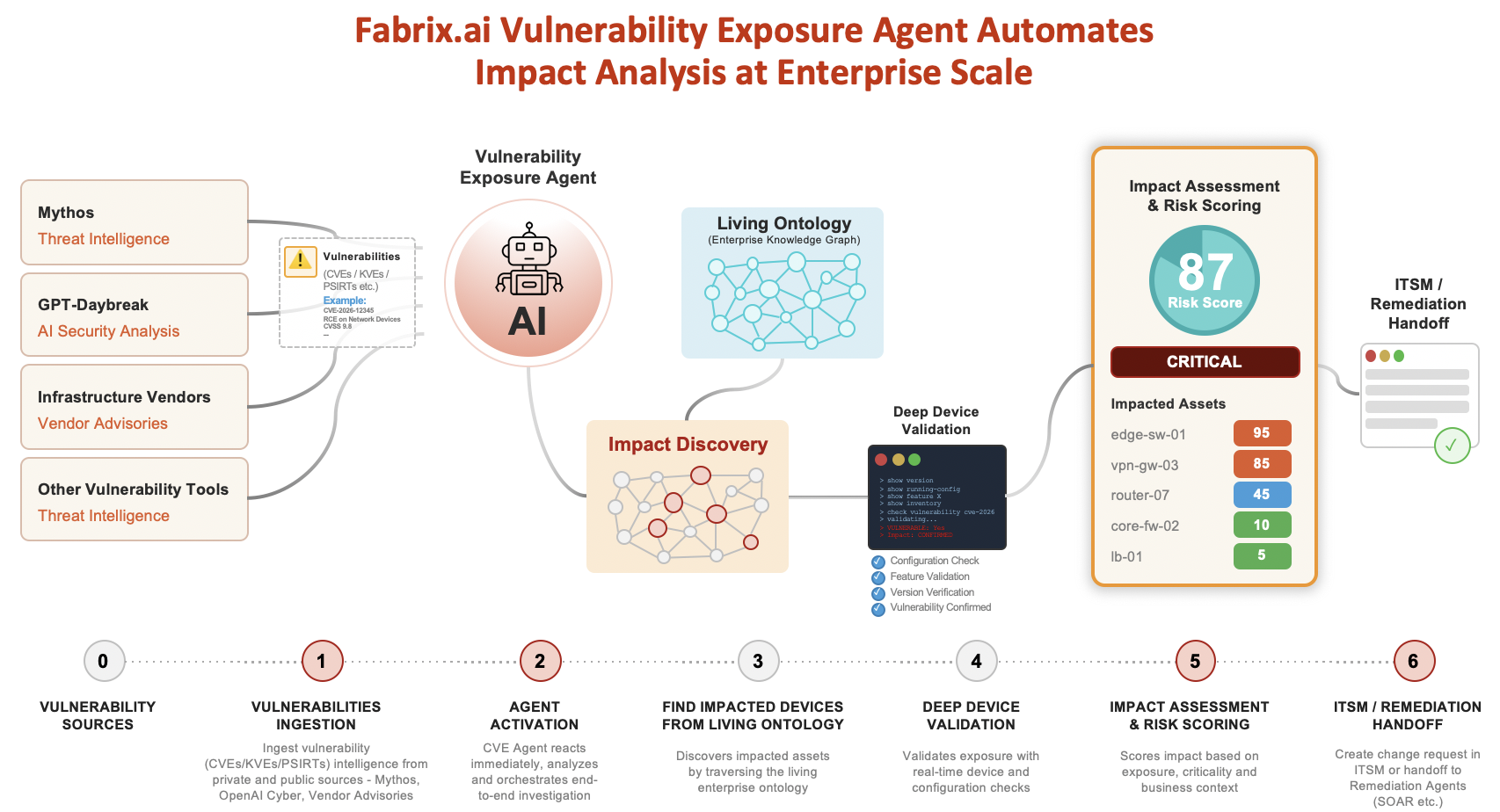
The pipeline begins by ingesting threat intelligence from sources like Mythos, GPT-Daybreak, and vendor advisories sharing CVEs, KVEs, and PSIRTs.. A concrete example in the diagram illustrates a CVSS 9.8 RCE vulnerability on network devices: exactly the kind of high-severity finding that demands immediate, accurate blast-radius analysis.
Vulnerability to Fix in 6 Stages
- Vulnerabilities Ingestion
Ingest vulnerability(CVEs/KVEs/PSIRTs) intelligence from private and public sources – Mythos, OpenAI Cyber, Vendor Advisories
- Agent Activation
VE Agent reacts immediately, analyzes and orchestrates end-to-end investigation - Find impacted devices from Living Ontology
Discovers impacted assets by traversing the living enterprise ontology - Deep Device Validation
Validates exposure with real-time device and configuration checks. Infrastructure-scale creates significant device validation challenges, which Fabrix solves with its intelligent data fabric platform. - Impact assessment and risk scoring
Scores impact based on exposure, criticality, and business context - ITSM / Remediation Handoff
Create a change request in ITSM or hand it off to Remediation Agents (SOAR, etc.)
Fabrix Living Ontology advantage
Once a vulnerability is ingested, the agent’s most powerful capability comes into play: traversal of Fabrix.ai’s Living Ontology, an enterprise knowledge graph that maps real-time relationships between devices, configurations, software versions, and business services. Rather than querying a static CMDB, the agent traverses live graph topology to discover every asset potentially in scope. This is what separates impact discovery from simple asset lookup.
In the diagram example, a single VE maps to five distinct network assets – edge-sw-01 scoring 95 (critical), vpn-gw-03 at 85, and router-07 at 45 – each with a calculated risk score reflecting actual exposure, not just theoretical vulnerability.
Deep validation before escalation
Before any ticket is created, the agent performs real-time device interrogation: configuration checks, feature validation, and version verification. This eliminates false positives at scale, only confirmed, exposed assets flow into the impact scoring stage. The result is an overall risk score (87 – Critical, in the example) grounded in live operational data, not stale spreadsheets. It can also quantify the extent of exposure and immediately trigger a patch prioritization agent that determines what needs to be fixed first, based on operational impact, exploitability, dependencies, and business criticality.
From there, a change request or remediation task is automatically created in the customer’s ITSM platform, or handed off to a SOAR agent for automated response. The human-in-the-loop moment arrives only when decisions need authorizing, not when data needs chasing.
Ex: CVE-2025-20352:
Cisco IOS and IOS XE Software SNMP Denial of Service and Remote Code Execution Vulnerability