

Every enterprise already collects oceans of operational data across dozens of tools ‐ observability, ITSM, networking, cloud, security, and cost. The problem has never been more data; it’s turning fragmented, multi-vendor signals into trustworthy action without a new integration project for every use case. Fabrix.ai solves this with a governed agentic platform built on a single foundation: Observability Pipelines.
Key takeaways
- Fabrix.ai’s governed agentic platform is built on Observability Pipelines, a deterministic data plane that ingests, normalizes, enriches, and streams operational data with no inference cost.
- VibeOps, AgentOps, and FinOps all draw on the same pipelines, MCP-based federation, Context Engine grounded in the ECL ontology, and governance harness.
- Fabrix agents query data where it lives through the RDAF MCP Server and Dynamic MCP Tooling, cutting time-to-first-value from 12 to 18 months down to weeks.
- Every vibe-coded app runs inside a six-pillar Agentic Operational Model and a five-step governed lifecycle: generate, version, test, review, and promote.
- Fabrix.ai produces its own topology through agentless discovery, enabling topology-based correlation that drives 90%+ alert-noise reduction and blast-radius impact analysis.
The foundation: Observability Pipelines
Fabrix’s Observability Pipelines are the deterministic data plane beneath everything. They ingest, normalize, enrich, and stream any operational data ‐ metrics, logs, events, traces, topology, configs, and cloud billing ‐ from thousands of pre-validated integrations into governed streams (pstreams). Because this work is deterministic, it runs with no inference cost, and streaming with batching keeps throughput high and predictable. Every capability below rides on this same pipeline layer, and every agent tool ultimately resolves to a pipeline, a query, or an API call.
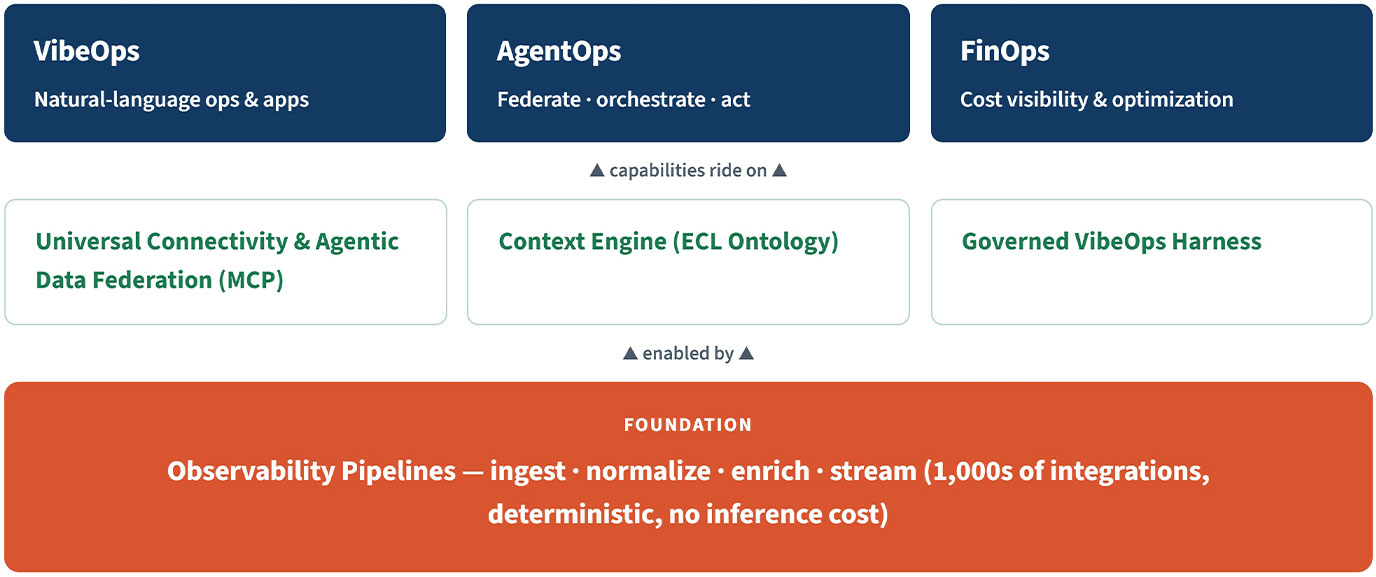
Three capabilities, one pipeline foundation
VibeOps lets any operator describe an app, dashboard, or automation in natural language and get a governed, real-time result ‐ grounded by Fabrix’s Argos domain-expert models so the output uses your exact configuration, not generic guesses. AgentOps runs agents that federate across your systems, orchestrate multi-step work, reason over unified data, and act within guardrails ‐ with full observability of every agent action, tool call, and token cost. FinOps ingests cloud billing (AWS CUR from S3, Azure and GCP Billing APIs) through pipelines into pstreams, then a FinOps agent and vibe-coded dashboards correlate usage, cost, and account signals to surface optimization recommendations across clouds. All three draw on the same pipelines, federation, context, and governance described next.
1 · Universal Connectivity: Agentic Data Federation with MCP
How it works
Rather than copying data into a new central store, Fabrix’s agents go to the data where it lives. Observability Pipelines act as the “tool handlers” that collect and normalize data, and Fabrix’s RDAF MCP Server exposes those capabilities as standards-based tools ‐ for example query_stream, run_pipeline, collect_device_config, and run_tests_on_device. Dynamic MCP Tooling (DMT) automates onboarding of a new source through a four-step flow: identify the data source, dynamically create an MCP endpoint, discover its schema, and wrap and normalize it as a governed tool. A shared operational ontology (ECL) is maintained automatically so any model can reason over the result without vendor lock-in.
Customer benefits
-
- No rip-and-replace. Your existing Splunk, Cisco, ServiceNow, cloud, and CMDB investments become agent-ready assets ‐ vendor-neutral, no central data lake required.
- The integration tax disappears. Each new use case no longer needs a new pipeline, schema mapping, and integration project ‐ driving time-to-first-value from 12–18 months down to weeks.
- Standards-based interoperability. Because capabilities are exposed over MCP, Fabrix plugs into the tools and agents customers already use, and is insulated from spec churn.
Your pipelines, consumable by any agentic layer
Fabrix’s Observability Pipelines are not locked behind a proprietary UI ‐ they are exposed, MCP-first, as governed tools and resources (for example query_stream and run_pipeline). That makes the relationship two-sided: Fabrix consumes other vendors’ MCP servers, and Fabrix publishes its own MCP Servers ‐ for Data Fabric and Automation Fabric ‐ that any other agentic layer can call over MCP and A2A. Whoever is orchestrating, the pipeline does the deterministic ingest, normalize, and enrich and returns governed data as a tool result.
This means the same pipelines that power Fabrix’s own VibeOps, AgentOps, and FinOps can serve as the governed data-and-action tool layer for:
-
- Splunk & Cisco Data Fabric ‐ plug Fabrix pipelines in as the observability data and action tools their agents call.
Telecom automation platforms ‐ expose network collection, config, and test pipelines as tools to existing OSS/BSS and automation stacks.
SIs building their own agentic layer ‐ build differentiated agent experiences on Fabrix’s governed pipelines instead of re-plumbing every integration. - No lock-in, two-sided value. Fabrix is both an MCP tool provider and an agentic orchestration platform ‐ partners consume Fabrix pipelines, and Fabrix consumes theirs, over open standards.
- Governance travels with the data. Because access runs through the MCP layer, role-based access, audit, and policy apply no matter which agentic layer makes the call.
- One integration, many consumers. A source onboarded once as a governed pipeline is instantly available as a tool to every agent and platform ‐ the integration tax is paid once, not per use case.
- Splunk & Cisco Data Fabric ‐ plug Fabrix pipelines in as the observability data and action tools their agents call.
2 · Context Engine: Grounded Reasoning on a Living Ontology
How it works
Agents are only as good as the context they’re given. Fabrix’s Context Engine assembles the right, minimal context for each agent from the federated data and the ECL ontology ‐ the semantic layer that turns raw pipeline output into meaning. Universal tooling and wrapping plus the pipeline layer let Fabrix present each agent exactly the data it needs, and Argos domain-expert models add grounded, domain-specific reasoning on top. The result is accurate answers tied to real evidence, with the ontology as the “fuel” and the agents and workflows as the engine.
Customer benefits
-
- Accuracy and less hallucination. Answers are grounded in your operational reality and traceable to source, not invented from a general model’s priors.
- Token and cost efficiency. Feeding each agent scoped context ‐ and running non-agentic work as deterministic pipelines with zero inference cost ‐ sharply reduces token spend, the FinOps of AI itself.
- Explainability by design. Because reasoning is anchored to the ontology and federated evidence, every conclusion can be audited and defended.
3 · The Harness: Governed VibeOps ‐ Speed with Trust
How it works
Fabrix’s vX (“Vibe-Coded User Experience”) lets teams keep the tools they love ‐ Cursor, Codex, Claude Code, OpenCode, AntiGravity ‐ connected to Argos and the Fabrix Agentic Platform to build operational apps, live dashboards, autonomous agents, and end-to-end automation. Every agentic action runs inside the six-pillar Agentic Operational Model ‐ Trust, Governance, Security, Observability, Explainability, and AgentOps ‐ so vibe-coded experiences operate under the same audit trail, role-based access, and policy enforcement as any production system. A five-step governed lifecycle (generate → version → test → review → promote) wraps every app, and enterprise properties come built in.
Customer benefits
-
- Production-ready autonomy. SSO, HA and geo-DR, full observability of agent actions, query costs and failures, and data governance with lineage ‐ inherited automatically, not built per app.
- Speed without technical debt. Vibe-coded velocity kept inside the trust, governance, and security envelope production demands ‐ closing the “vibe governance” gap.
- Cost-governed at every step. Deterministic pipelines carry non-agentic work at no inference cost; agentic work is scoped and bounded; Fabrix manages the platform end to end.
Real-Time Topology Discovery ‐ the Enrichment Others Can’t Match
Enrichment is only as good as the context behind it, and the richest context in operations is an accurate, current map of how everything connects. Fabrix discovers that map itself. Agentless discovery pipelines ‐ SNMP, NetFlow, and deep discovery via RDA Edge, no agents on the devices ‐ continuously build a live dependency graph in a graph database, then feed it back into the Observability Pipelines two ways:
-
- Enrichment: service maps and dependency/impact maps attach topological context to incoming telemetry and events ‐ and Fabrix pushes that enrichment into platforms like Splunk ITSI to sharpen KPI health scoring.
- Topology-based correlation: related alarms collapse into a single incident ‐ a downed link’s two traps become one incident ‐ driving 90%+ alert-noise reduction and blast-radius impact analysis.
Why it’s different: a topology producer, not a consumer
Most AIOps and observability tools are topology consumers ‐ they enrich from a CMDB or imported monitoring topology they import, which is often stale, CI-centric, or incomplete. Fabrix is a topology producer: it discovers the network directly, near-real-time and asset/persona-centric, and can even feed topology into Splunk and Cisco data fabrics as an enrichment source. That edge is decisive exactly where imported topology fails ‐ telecom, greenfield, and multi-vendor networks with no trustworthy CMDB.
| Approach | How topology is obtained | Freshness & role |
|---|---|---|
| Fabrix | Actively discovered ‐ agentless SNMP / NetFlow / deep discovery | Near-real-time, continuously refreshed; a producer that feeds other platforms |
| Typical AIOps | Imported from CMDB and monitoring tools | Only as fresh as the source, often stale; a consumer |
| CMDB / ITSM | Batch discovery / service mapping, CI-centric | Frequently lagging; system of record, not real-time |
The foundation for Agentic NetOps. Gartner’s emerging Agentic NetOps category is about agents that autonomously change, troubleshoot, and optimize networks under governance. Agents cannot safely act on a network they cannot model ‐ a real-time topology graph is the precondition. Fabrix pairs that graph with governed, policy-bounded remediation, making it agentic-NetOps-ready by design rather than a visualization add-on.
How Each Capability Leverages the Three Enablers
| Capability | Universal Connectivity & Federation (MCP) | Context Engine | Governed VibeOps Harness |
|---|---|---|---|
| VibeOps | Reaches any source as a governed MCP tool; pipelines feed the streams behind every app | Argos + ontology ground natural-language apps in exact, valid config | Five-step governed lifecycle; SSO, HA/DR, observability inherited |
| AgentOps | Agents federate across existing tools with no central store | Scoped, token-efficient context per agent; grounded reasoning | Every action audited, permissioned, and cost-tracked under six pillars |
| FinOps | Pipelines ingest AWS CUR / Azure & GCP billing as federated data | Correlates usage, cost, and account signals into recommendations | Deterministic pipelines = zero inference cost; recommendations governed and trackable |
Outcomes for the Enterprise
- Weeks, not quarters. Time-to-first-value collapses as the integration tax disappears.
- MTTR → MTTP. From reacting to incidents to predicting and preventing them.
- Vendor-neutral. Existing Splunk, Cisco, ServiceNow, and cloud investments become agent-ready.
- Cost-governed AI. Deterministic pipelines and scoped context keep inference spend bounded.
- Auditable & sovereign. Every agentic action is permissioned, observable, and defensible.
- One control plane. VibeOps, AgentOps, and FinOps on a single governed foundation.
The enterprise doesn’t have a vibe coding problem ‐ it has a vibe governance problem. Fabrix’s Observability Pipelines, federation, context, and harness close that gap.
About Fabrix.ai. Fabrix.ai (formerly CloudFabrix) is the agentic AI company for operational intelligence. Its platform integrates Data Fabric, AI Fabric, and Automation Fabric to deliver autonomous IT operations with enterprise-grade trust and governance, and its Cross-Domain Governed VibeOps platform, powered by Argos , is available now. Fabrix.ai serves Global 2000 enterprises through partnerships with Cisco, Splunk, IBM, and AWS, and is headquartered in Pleasanton, California. Learn more at fabrix.ai.
Frequently Asked Questions
What are Fabrix.ai Observability Pipelines?
Fabrix.ai Observability Pipelines are the deterministic data plane beneath the Fabrix.ai platform. They ingest, normalize, enrich, and stream operational data, including metrics, logs, events, traces, topology, configs, and cloud billing, from thousands of pre-validated integrations into governed streams called pstreams. Because the work is deterministic, it runs with no inference cost, and every agent tool ultimately resolves to a pipeline, a query, or an API call.
What is governed VibeOps?
Governed VibeOps lets operators build apps, dashboards, and automations in natural language with tools like Cursor, Codex, Claude Code, OpenCode, or AntiGravity, while keeping them under production controls. In Fabrix.ai, every agentic action runs inside a six-pillar model of Trust, Governance, Security, Observability, Explainability, and AgentOps, and each app follows a five-step lifecycle: generate, version, test, review, and promote.
How does Fabrix.ai use MCP for data federation?
Fabrix.ai agents go to data where it lives instead of copying it into a central store. The RDAF MCP Server exposes pipeline capabilities as standards-based tools such as query_stream and run_pipeline. Dynamic MCP Tooling onboards a new source in four steps: identify the source, create an MCP endpoint, discover its schema, and wrap it as a governed tool. Fabrix.ai also publishes MCP Servers other agentic layers can call.
How does Fabrix.ai reduce LLM token costs in IT operations?
Fabrix.ai reduces token spend in two ways. Non-agentic work runs as deterministic Observability Pipelines with zero inference cost. For agentic work, the Context Engine assembles the minimal, scoped context each agent needs from federated data and the ECL ontology, so agents do not process unnecessary data. Agentic work is also scoped and bounded, with token cost tracked for every agent action.
How is Fabrix.ai topology discovery different from CMDB-based topology?
Fabrix.ai is a topology producer rather than a consumer. Most AIOps tools import topology from a CMDB or monitoring tools, which is often stale or incomplete. Fabrix.ai discovers the network directly through agentless SNMP, NetFlow, and deep discovery via RDA Edge, building a near-real-time dependency graph. It can feed that topology into Splunk and Cisco data fabrics, which matters most in telecom, greenfield, and multi-vendor networks.
