Why the next era of enterprise AI isn’t about note-taking — it’s about digital workers who actually show up and do the work.
There’s a moment every IT operations leader knows well.
A critical incident hits at 2 PM on a Tuesday. Within minutes, a war room meeting spins up — a Google Meet or Teams call crowded with network engineers, SRE leads, cloud architects, and storage admins, all staring at dashboards and talking over each other. Someone is manually pulling syslog data. Someone else is waiting on another team to check SNMP traps. The incident bridge becomes a game of telephone: information requested, relayed, interpreted, misheard, and re-requested.
The information exists. The people to act on it exist. The problem is coordination, speed, and the sheer cognitive load of assembling context under pressure.
| This is exactly the scenario that drove us to build Agent Collab — and it’s why we believe the future of AI in enterprise isn’t a smarter note-taker. It’s a true digital coworker. |
A Brief History of AI in Meetings (and Why It Falls Short)
The last two years have seen an explosion of AI meeting assistants. They join your call, transcribe everything, and deliver a neat summary with action items afterward. If you haven’t tried one, they’re genuinely impressive — for about a week.
Then you notice the limitation: they are entirely passive. They listen. They record. They summarize. But they never actually do anything.
When your SRE team is live-troubleshooting a P1 outage, a passive AI that logs “Action Item: Check network utilization on PE-LAX-02” is nearly worthless. The value isn’t in capturing that someone said it — it’s in actually going and getting that data, right now, while everyone is still on the call.
This is the gap. And it’s enormous.
Introducing Fabrix Agent Collab
At Fabrix.ai, we build AI agents — what we call Digital Workers — that are purpose-built for IT operations domains: NetOps, SecOps, SREOps, FinOps, and more. These agents don’t just answer questions; they take actions, run diagnostics, execute automation pipelines, query monitoring systems, and surface insights from live operational data.
With Agent Collab, we’ve done something deceptively simple but genuinely transformative: we’ve given these Digital Workers the ability to join your meetings.
| Not to take notes. To work. |
What Active AI Collaboration Actually Looks Like
Picture this scenario. Your team has assembled on a call to respond to a major network incident. The Fabrix NetOps Agent has been invited to the meeting. It joins, announces itself, and begins listening.
An engineer says:
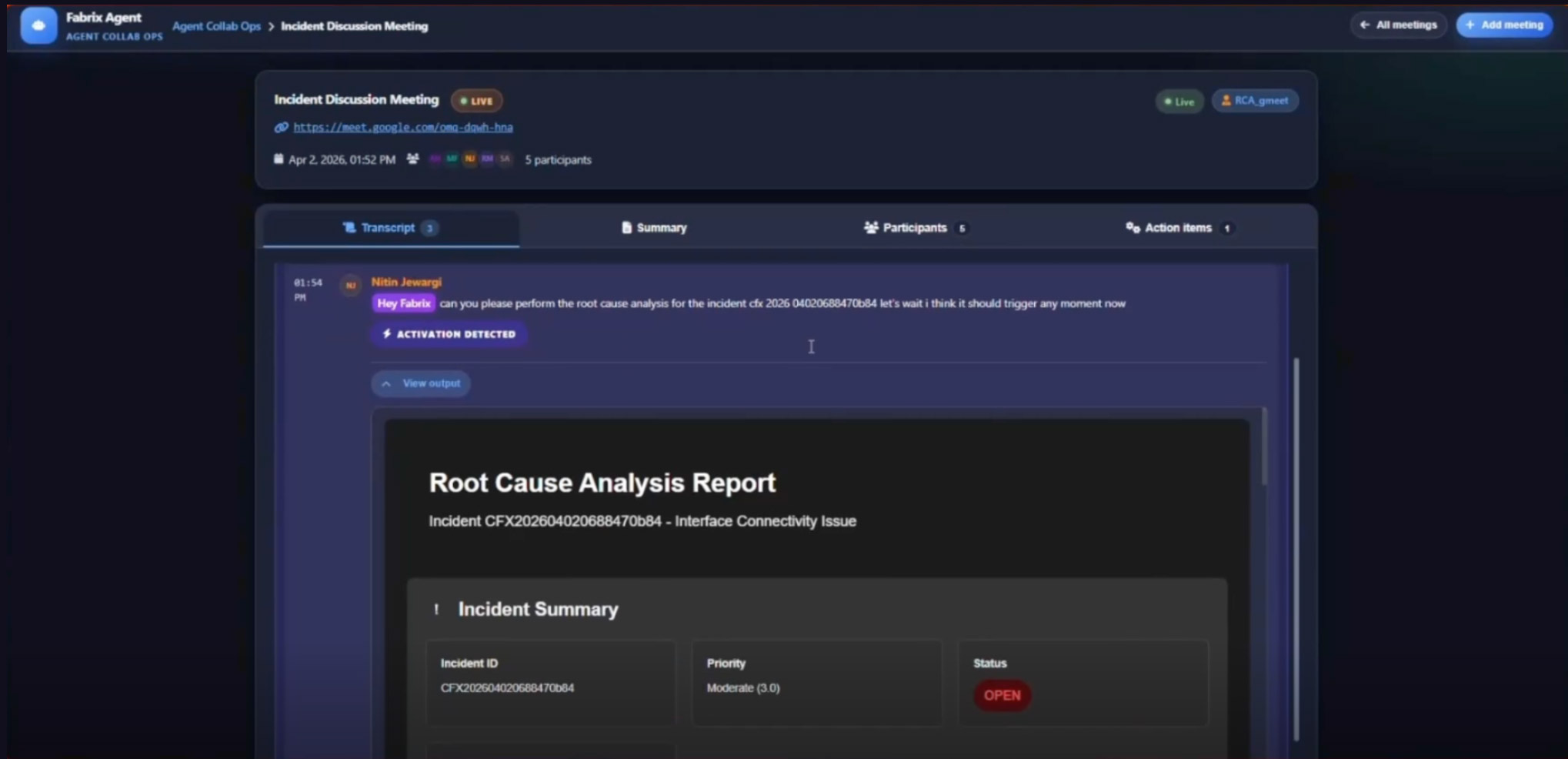
“Hey Fabrix, perform the root cause analysis for incident CFX-202604020688.”
Within moments — while the team is still on the call — the agent retrieves the incident record, correlates related alerts, checks syslog data and SNMP traps, identifies a link-down event on a core interface, and delivers a structured RCA report, surfaced directly in the meeting chat alongside a voice summary.
No tickets. No waiting for another team. No tabbing between five monitoring tools. The agent did in 30 seconds what might otherwise take 20 minutes of manual coordination.
Consider a routine network capacity planning review. An engineering lead says: “Hey Fabrix, pull a current bandwidth utilization report for our top 5 network segments with utilization percentages and risk levels.” The agent surfaces a structured bottleneck analysis — delivered in real time, directly into the meeting.
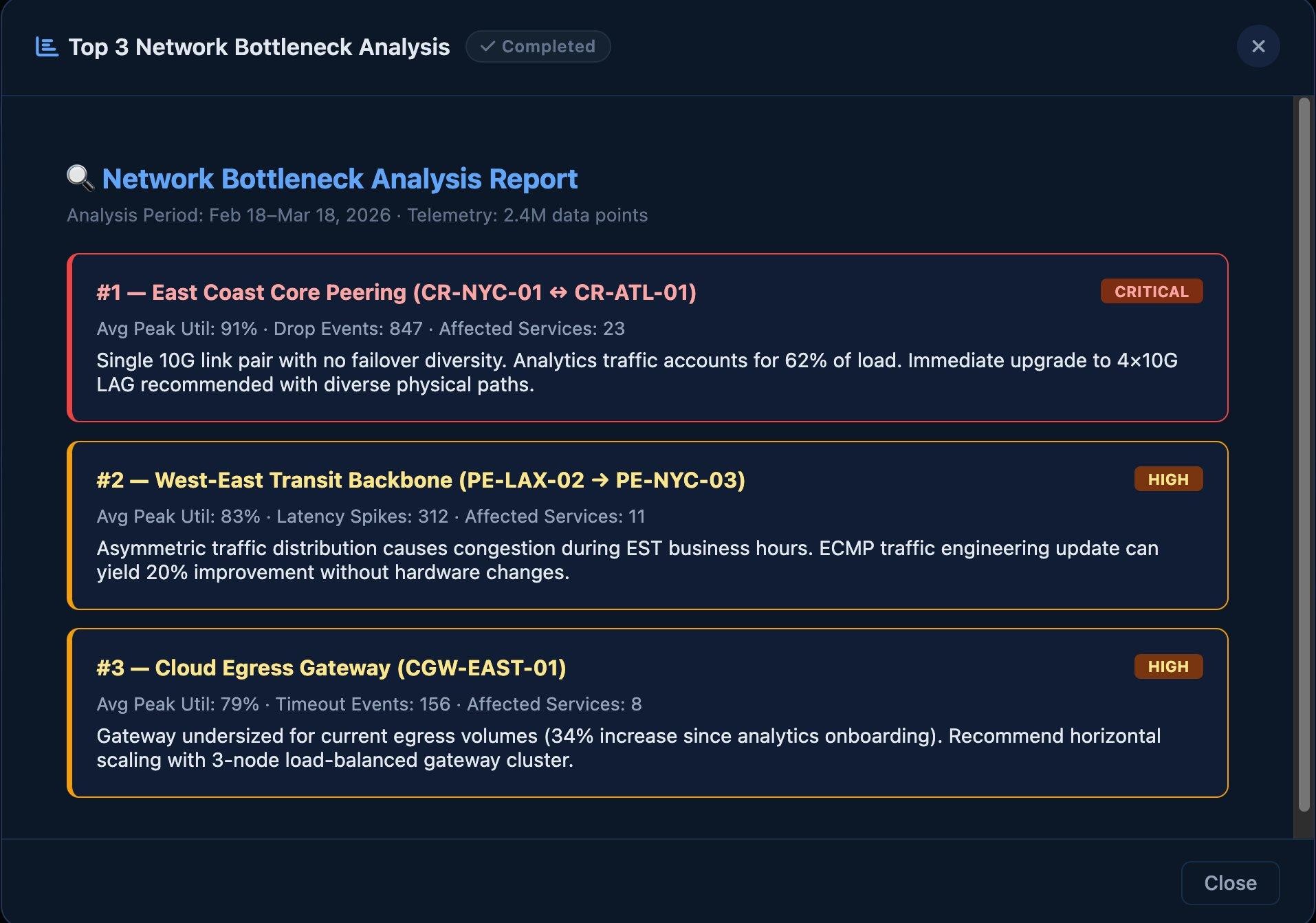
Fabrix NetOps Agent surfacing a live network bottleneck analysis report during a capacity planning meeting
The team doesn’t need to pause the conversation. They make decisions with live data, not after it.
How Agent Collab Works
Getting an agent into your meeting takes less than a minute.
From the Fabrix portal, you provide a meeting URL (we support Google Meet, Microsoft Teams, Zoom, and Webex), select a meeting label, choose a Meeting Profile — a pre-configured template that governs how the agent behaves in sessions — and select which agent to invite.
The agent joins the meeting as a named participant, announces itself, states that the session will be transcribed for agentic task capture, and begins listening for its activation phrases (like “Hey Fabrix” or “Hi Fabrix”). From that point, any team member can invoke it verbally, just like they’d ask a colleague a question.
When a task is triggered, the agent:
- Acknowledges the request verbally and in meeting chat
- Executes the task — querying live systems, running diagnostics, invoking automation pipelines, or retrieving structured data
- Returns results in both voice and text form, displayed in the meeting chat in real time
Every action is logged. Every output is retrievable. Every invocation is captured in the full meeting transcript with clear attribution.
After the meeting ends, the platform generates a complete meeting summary, a participant attendance log, and a structured action item report showing every task the agent executed — including the prompt, the status, who requested it, and when.
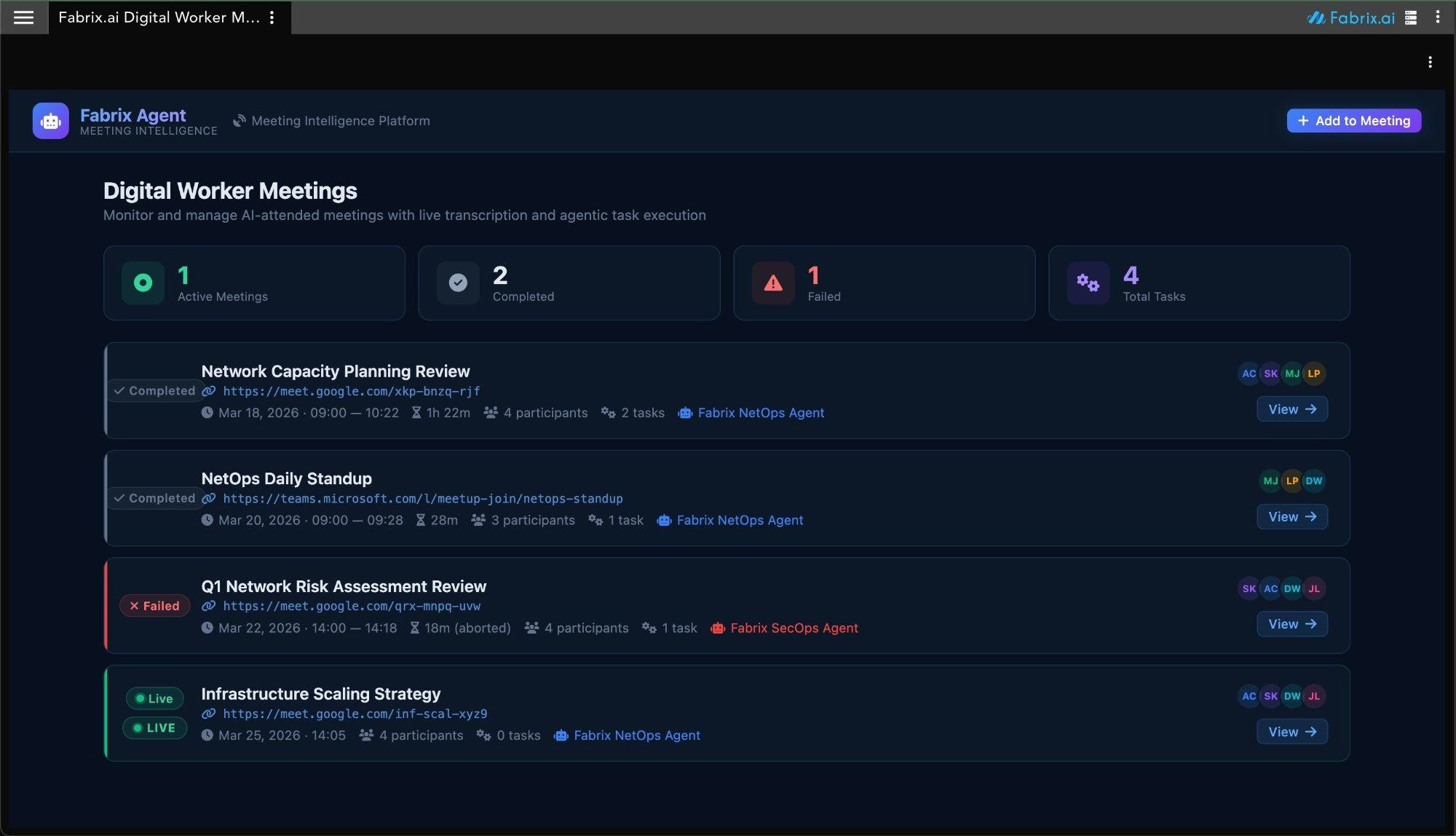 The Fabrix Digital Worker Meetings dashboard — tracking active, completed, and failed sessions with per-meeting agent activity
Built for Enterprise: Security, Governance, and Control
Inviting an AI agent into a live business meeting raises legitimate questions about security and oversight. We’ve thought carefully about this.
- Meeting invite tokens. When you invite an agent to a meeting, the session is protected by a per-meeting token that changes for every session. Without it, the agent cannot participate. This eliminates the risk of an agent being inadvertently admitted to an unintended meeting through a stale or incorrect URL — a real concern in enterprise environments where meeting links get forwarded, archived, and reused.
- Human-in-the-loop controls. Sensitive operations — whether information retrieval involving restricted data or task execution with system-side effects — require explicit human approval before the agent proceeds. Guardrails are configurable per agent persona and per meeting profile.
- Meeting profiles. Admins configure meeting profiles that govern agent behavior: activation phrases, auto-disconnect policies (the agent drops if the meeting goes idle for a defined period, or if it’s the last participant), maximum meeting duration, and per-session AI spend limits.
- Complete audit trail. Every meeting is logged with full transcript, participant details, agent actions, outputs, and timestamps — accessible through an admin dashboard with summary analytics across all sessions.
- Data retention controls. Transcription data, attendee details, and meeting records are subject to configurable retention policies, ensuring compliance with data governance requirements.
Beyond Meetings: Agents in Your Collaboration Channels
Agent Collab isn’t limited to live video calls. Fabrix.ai agents are also available directly in Slack, Microsoft Teams, and Webex workspace channels.
In these environments, teams can invoke agents inline — mention the agent by name, issue a prompt, and get a structured response posted back to the channel within seconds. This makes agents accessible for asynchronous operations work: checking the status of a service, pulling a report, or kicking off a diagnostic — without spinning up a meeting at all.
The same security model, audit logging, and governance controls apply across both surfaces.
Looking Ahead
We’re investing heavily in making Digital Workers more natural and ambient collaborators — less like tools you invoke and more like colleagues who are genuinely present. The roadmap ahead is about depth of presence, not just breadth of capability.
Longer term, we see a world where Digital Workers aren’t just invitees — they’re standing members of operational teams, with persistent context about your environment, your incidents, your runbooks, and your team’s working patterns. A world where the war room doesn’t just have a Fabrix agent on the call — it has one that already knows the last three incidents on that circuit, which engineers own which segments, and can help predict what happens next.
We’re building toward that. Agent Collab is the foundation.
The Shift We’re Describing
There’s a conceptual shift embedded in everything we’ve built here, and it’s worth naming directly.
For the last decade, “AI in the enterprise” has largely meant AI as a tool — something you open, query, and close. The current generation of meeting AI is an extension of that model: the tool joins the meeting, but it’s still fundamentally passive infrastructure.
| We believe the next era belongs to AI as a colleague — something that holds a role, carries context, responds to verbal direction, and takes meaningful action. Something that earns its seat at the table. |
That’s the vision behind Digital Workers at Fabrix.ai. And Agent Collab is where that vision becomes something your team can use in production, today.
Fabrix.ai Agent Collab is now available in Preview for enterprise customers. Supported meeting platforms include Google Meet, Microsoft Teams, Zoom, and Webex. Collaboration channel support includes Slack, Microsoft Teams, and Webex.
To learn more visit Fabrix.ai or contact us to schedule a Demo